

Environmental Science Students Participate in Model USDA 2026 at Arizona State University
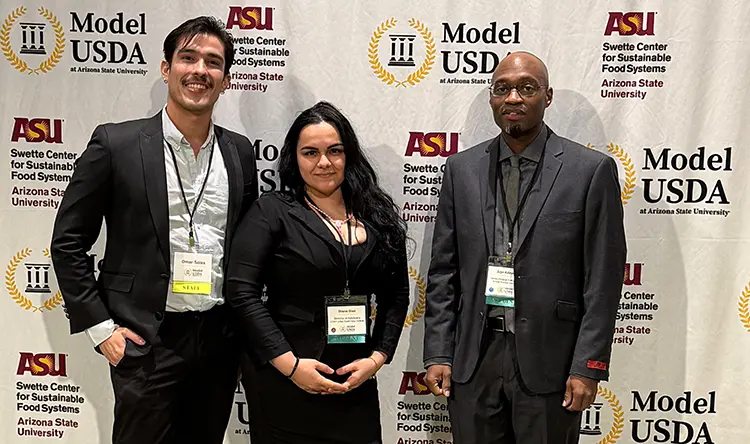
LONG ISLAND CITY, NY (February 4, 2026) — Students at LaGuardia Community College/CUNY are taking an active role in learning about agricultural policy at a national level. Recently, two Environmental Science students, JoJo Adeyemi and Diana Diaz, and Environmental Science Program Coordinator Omar Salas Lopez attended the Model USDA Congress in Tempe, Arizona, for a first-of-its-kind, hands-on experience in agricultural policy, career exploration, and understanding the role of the U.S. Department of Agriculture (USDA).
Dr. Preethi Radhakrishnan, Professor of Biological Sciences and Director of the Environmental Science program, said participation in this national event, from January 30 through February 1, was supported by the U.S. Department of Agriculture (USDA) NextGen $4.5 million grant, awarded to LaGuardia in 2023.
Dr. Radhakrishnan said the grant initiative supports Environmental Science students through paid summer residencies, peer-mentorship, career development opportunities, and a fully funded scholarship program between LaGuardia and Rutgers University which would serve as pipeline for inner-city high school students in NYC to careers in Food, Agriculture, Natural Resources, and Human Resources (FANH) that are currently unavailable to them near their homes.
“This was a significant professional and academic opportunity, and they represented LaGuardia at the national level,” Dr. Radhakrishnan said. “We were one of the few community colleges presented with the opportunity.”
Model USDA is a multi-day simulation for college students in the USDA NextGen program. Launched in 2025 by Arizona State University’s Swette Center, this conference gives students a unique opportunity to step into the shoes of federal food policy decision-makers and stakeholders. Inspired by Model United Nations and Model Congress, Model USDA is designed to engage, educate, and empower the next generation of leaders in food and agriculture policy.
Conference organizers invited 194 students and 61 faculty from 31 institutions hailing from 27 states including Puerto Rico, Guam, Northern Mariana Islands and Washington DC.
At the conference students were assigned a role and divided into six groups. Each group was assigned a policy scenario, which was their focus throughout the three days of Model USDA. The scenarios were based on real-world food and agriculture challenges, and roles range from USDA officials and nonprofit advocates to scientists, educators, and industry leaders. In their roles, students debated, negotiated, and co-created policy solutions.
For his scenario, JoJo, an Environmental Science student concentrating in Sustainable Urban Agriculture, was assigned the role of a Senior Federal Policy Analyst representing the School Nutrition Association (a public stakeholder).
“We were given the task to step into the role of real-world food and nutrition policy stakeholders to examine whether and how environmental sustainability should be incorporated into the Dietary Guidelines for Americans,” JoJo said. “The scenario group started with a one-minute open forum speech explaining our position to the other participants. Then we were given a short lecture from a nutrition expert about the history of how the dietary guidelines were created, how that process has changed and relevant background information about the new guidelines created in January of this year.”
JoJo said even though his role was smaller, he was able to actively participate and build a coalition of farmers, food industry professionals, and environmental and nutrition experts in his scenario.
“I asked their concerns and came up with a plan,” he said. “After a discussion with the Chief of Staff for the USDA, I made my case backed by my evidence, and I was able to secure a pledge for the only funding that ended up on the final proposal. It amounted to $500 million for a national pilot program for scratch-made meals and the associated staff and labor costs.”
Diana, an Environmental Science student concentrating in Animal Science, said attending MODEL USDA allowed her to gain a deeper understanding of how federal policy is shaped, particularly how legislation related to food and nutrition moves from proposal to implementation.
“I was able to witness firsthand how critical collaboration is between the USDA, community organizations, researchers, and school systems when making decisions that directly impact children and underserved communities,” Diana said. “The experience made clear that effective policy cannot exist without stakeholder input, credible data, and real-world perspectives.”
During the simulation, Diana served as the Director of Advocacy for the CUNY Urban Food Policy Institute, a role that required her to represent the interests of urban, low-income, and historically underserved school districts.
“In this position, I advocated for healthier, more sustainable food systems within schools, particularly those serving students who rely heavily on school meals for daily nutrition,” she said. “Stakeholder discussions emphasized that a large percentage of students consume up to two-thirds of their daily meals at school, making nutrition education and food quality essential to student success, behavior, and long-term health outcomes.”
In her scenario, Diana said one of the major challenges presented by the task force was a proposed $10 million budget with restrictive guidelines, unclear program models, and limited flexibility for local decision-making.
“As a stakeholder, I actively negotiated to ensure that low-income school districts were not excluded due to rigid criteria,” Diana said. “Through evidence-based arguments and coalition building, I successfully advocated for a $150,000 grant allocation for New York City’s poorest school districts, ensuring they had access to resources needed to implement effective nutrition and sustainability programs.
In addition, Diana said she was able to advocate for the inclusion of U.S. territories, such as Puerto Rico, Guam, and the U.S. Virgin Islands, which are often overlooked in federal funding frameworks.
“I emphasized that food insecurity, nutrition disparities, and access challenges extend beyond the continental United States,” Diana said. “As a result of this advocacy, the task force approved the inclusion of U.S. territories in the second round of grant funding, a decision that reinforced the importance of equity in national policy.”
“This experience exposed me to the wide scope of responsibilities under the USDA umbrella, including grant administration, program evaluation, stakeholder engagement, data collection, reporting requirements, and oversight by USDA Food and Nutrition Services,” Diana said. “I learned how evaluation tools such as pre and post-nutrition knowledge assessments, behavioral change measurements, and Healthy Eating Index data are used to justify funding decisions and program continuation.”
JoJo said he felt encouraged and motivated by everyone who participated because they were genuinely invested not only in the conference but in making positive changes to our food system and the agricultural industry.
“There were definitely some future leaders in the making,” JoJo said. “Events like this always help to reaffirm that a career in agriculture is right for me, and it made me aware of the many avenues available to food producers and food industry professionals in the ag industry, even if one can’t physically do farm labor.”
Diana says the experience offered valuable opportunities to learn new skills that she can use in her career.
“MODEL USDA taught me how to negotiate, advocate, and speak up for communities whose voices are often unheard,” Diana said. “Being part of a diverse group of stakeholders with differing priorities showed me that progress is possible when evidence, empathy, and collaboration guide decision-making.”
JoJo says the experience was worthwhile and recommends other students sign up if they can.
“It was valuable in learning how decision makers and public stakeholders intersect to create policy,” he said. “I would advise any future students not to let impostor syndrome or self-doubt prevent them from taking advantage of the learning experience and growth potential that events like Model USDA provide. The networking opportunity with industry leaders and like-minded professionals alone made it worthwhile.”
As an observer, Omar said it was impressive to watch students debate and express their perspectives with the seriousness of an actual congressional session.
“Jojo and Diana stood out,” he said. “They strongly defended their beliefs, articulated their arguments clearly, and successfully advocated for their proposals, ultimately getting their budgets approved. Watching them navigate opposition, compromise when needed, and remain confident in their positions was a powerful reminder of how transformative experiential learning can be.”
Dr. Radhkrishnan said the experiences of JoJo and Diana reaffirm the critical role that urban community colleges play in shaping agricultural policy.
“Their insights, which are deeply rooted in local food systems and environmental justice, are not only valid, but necessary, given that CUNY data indicate most of our students rely on SNAP and face food insecurity (exasperated by the recent government shutdown),” Dr. Radhakrishnan said. “This makes students like Jojo and Diana uniquely qualified to inform policies that directly affect their communities – and I hope they do someday!”
• • • •
LaGuardia Community College (LAGCC), a Hispanic-Serving Institution, located in Long Island City, Queens offers more than 50 associate degrees and academic certificates, and more than 65 continuing education programs to prepare New Yorkers for transfer to senior colleges and rewarding jobs and careers. An institution of the City University of New York (CUNY), the College reflects the legacy of our namesake, Fiorello H. LaGuardia, the former NYC mayor beloved for his advocacy of the underserved. Since 1971, LaGuardia’s academic programs and support services have advanced the socioeconomic mobility of students from Queens, NYC and beyond.
####