

Administrative and Educational Support (AES) Units Assessment
Contact Us
Room: E-Building, E-512
Phone: (718) 482-6119
IE@lagcc.cuny.edu

Administrative and Educational Support (AES) units assessments examine how effectively the units are achieving their goals and objectives including meeting the needs and expectations of students, parents, employers, faculty and other stakeholders. AES units can also assess Student Learning Outcomes within the context of the unit’s services and the co-curricular experiences.
Educational Outcome Design and Organizational Assessment
Assessment is a reflective, iterative process aimed at making improvements. Quality assessment adheres to the following pillars:
- Systematic and Strategic: It is planned and purposeful. As a systematic approach, the plan needs to be periodically reviewed and potentially refreshed as new information or activities occur.
- Evidence-Informed: Evidence that can be made actionable is the core of the planning process. Evidence is collected, evaluated, and iteratively informs the planning process.
- Enhances Decision-Making: The process focuses on making decisions such as departmental improvement, developing action plans or interventions, and informing strategic direction.
- Useful and Used: The assessment process aims to constantly take in information and strategically apply the results in a way that leads to Continuous Improvement. The goal is to take action by applying what was learned to make the Unit more effective.
Assessment is an important part of the Institutional Effectiveness (IE) process, enabling an organization to measure its performance in achieving its mission and stated goals. Through continuous, evidence-driven improvement efforts, the college makes evidence-informed decisions that guide its operations and resource allocation.
Assessing Administrative and Educational Support (AES) Units
Assessment allows us to demonstrate achievement of the college’s mission. At the college, organizational assessment occurs at the level of Administrative and Educational Support (AES) Units, which align with the college’s Strategic Plan.
This supports Institutional Effectiveness by demonstrating the degree to which the college is achieving its mission through ongoing assessment and continuous improvement, as evidenced by annually tracking the progress made in achieving institutional and program level goals, assessing the attainment of the College strategic goals, the student learning and program level goals, and evaluating the quality of programs and services. Each of these processes is not only critical for assessing continuous improvement, but it also conforms to the expectations of the Middle States Commission on Higher Education (MSCHE) assessment and planning standards.
The AES assessment efforts are supported by two major mechanisms at the college, including the Office of Institutional Research and Effectiveness (OIRE) and the AES Assessment Council.
OIRE supports the college’s efforts to close the loop on assessment practices. By providing a strategic framework across the college, the AES efforts have commonality across units. OIRE also serves to provide resources, training, feedback, and expertise on designing organizational assessment on an ongoing basis to the college’s administrative units. In collaboration with division leads, the college has an assessment process that ensures alignment of the college’s continuous improvement efforts, planning, and organizational outcomes to improve overall institutional effectiveness.
AES Assessment Council Mission: The Administrative and Educational Support (AES) Assessment Council guides LaGuardia’s AES units through ongoing systematic assessment and continuous improvement of their programs, services, and related student learning to support the College’s progress toward achieving its mission and institutional goals.
Members of AES Assessment Council support these key responsibilities through three critical contributions:
- Council Membership: Serve as members of the AES Assessment Council, advising on matters of assessment at the college, proactively supporting assessment planning and processes, and serving as strategic partners for implementing organizational assessment. Council meetings are also an opportunity to share best practices to facilitate and improve the assessment process.
- Support of Assigned Units as a Liaison to the Council: Members of the Council serve as direct Liaisons to their Division and assigned Units providing support, acting as advocates for the AES process, and proactively supporting effective, meaningful assessment that informs continuous improvement. Liaisons help Units to define and remain on schedule toward completion of their Periodic Unit Review (PUR) and/or their Annual Assessment Tracking.
- Advocacy and Communication: Liaisons are responsible for keeping their Division head and Unit leads informed about AES updates and annual progress. Liaisons also serve to advocate for and ensure that the college is aware of the significant efforts of those conducting the work of organizational assessment across the college.
| Name | Division |
|---|---|
| Marina Abramova | Adult and Continuing Education (ACE) |
| Gail Baksh-Jarrett | Enrollment Management |
| Aimeelyn Calandria | Development / Foundation |
| Charlie Elias | Division of Administration |
| Kevin Martin | President’s Office (OIRE) |
| Rejitha Nair | Division of Academic Affairs |
| Emad Nassar | President’s Office (OIRE) |
| Cristina Natale | Division of Administration |
| Randi Nieves | Grants Office |
| Fawad Rahmani | Student Affairs |
| Georgina Taraskewich | Communications and External Affairs |
| Jessica Zeichner-Saca | Grants Office |
AES Assessment Council
The AES Assessment Council guides LaGuardia’s Administrative and Educational Support units through ongoing systematic assessment and continuous improvement of their programs, services, and related student learning in order to support the College’s progress toward its mission and institutional goals.
Members of AES Assessment Council support these key responsibilities through three critical contributions:
- Support the assessment planning and processes: AES Assessment Council members attend monthly meetings. The Council initial task was to collectively review and assist with the design of the annual assessment plans and periodic unit reviews. Subsequently to finalizing the assessment plans, the committee meetings are dedicated to collaborating and learning from members’ experiences documenting the best ways of facilitating and improving the process.
- Division liaison: Lead, facilitate and support the assessment work of the units within their division. The Council members provide training as needed and monitor units’ progress in completing their annual and periodic assessment plans and provide feedback and guidance. Members also collaborate with OIRA in ensuring the units assessment efforts are effective and used for ongoing improvement.
- Support the Periodic Unit Review: The AES Council member will be the initial reviews for PUR studies. Following their feedback and units’ subsequent editing and revisions, the PURs will be submitted to either an external or internal reviewers.
The AES Assessment Process
AES units apply cycles of inquiry, undergo annual assessments, receive feedback, and reflect on what they learn to take evidence-informed action to improve their processes, planning, and outcomes (including learning outcomes) and to contribute to the college’s and divisions’ successful accomplishment of their missions and priorities. While the assessment process is cyclical, the idea of continuous improvement should yield efforts that continuously build and improve upon past efforts.
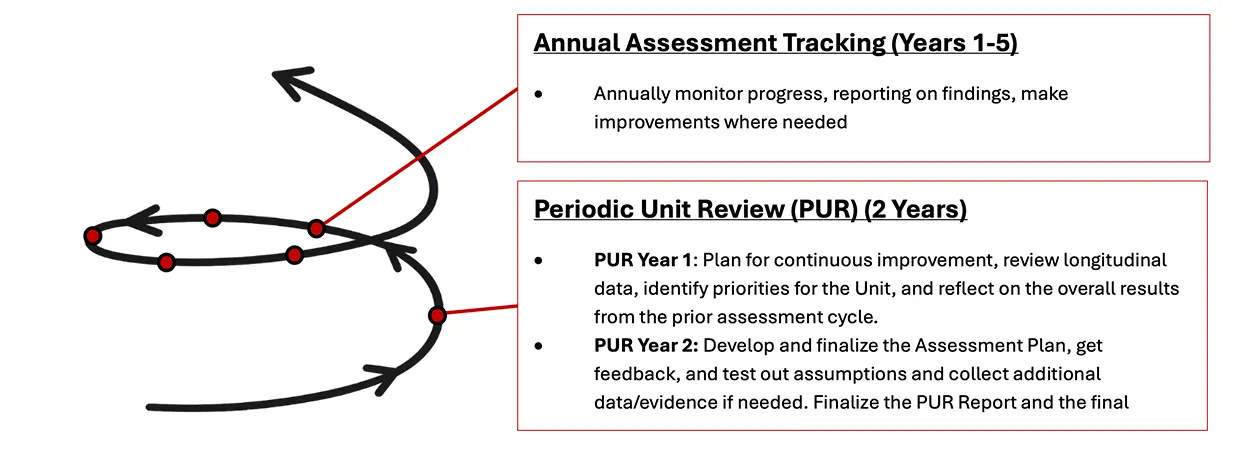
AES Assessment Process Visual
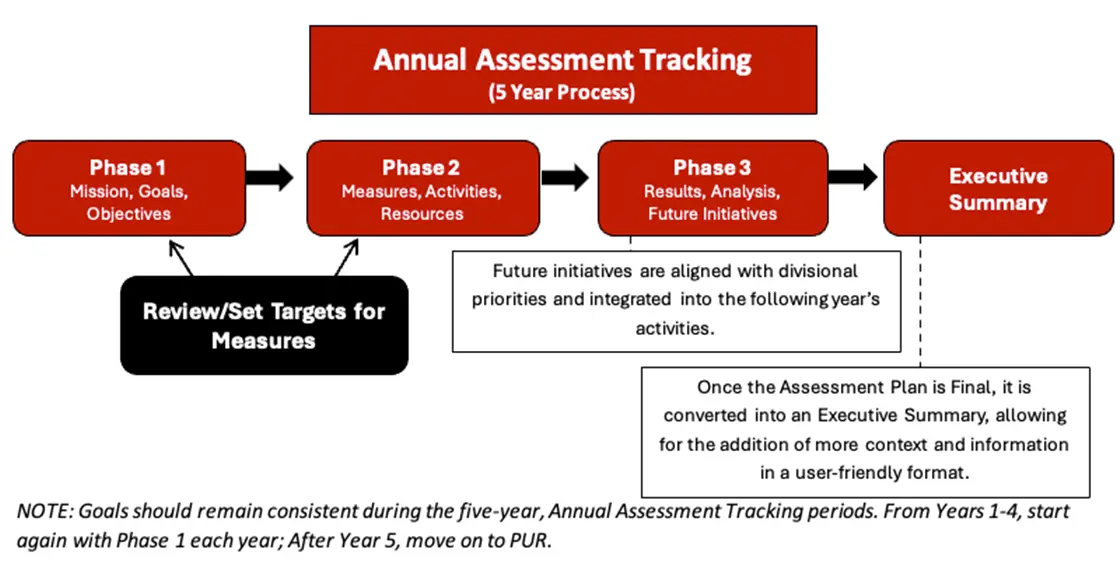
The PUR process bookends annual tracking cycles, allowing for review of the last annual tracking cycle and rethinking for the next one.
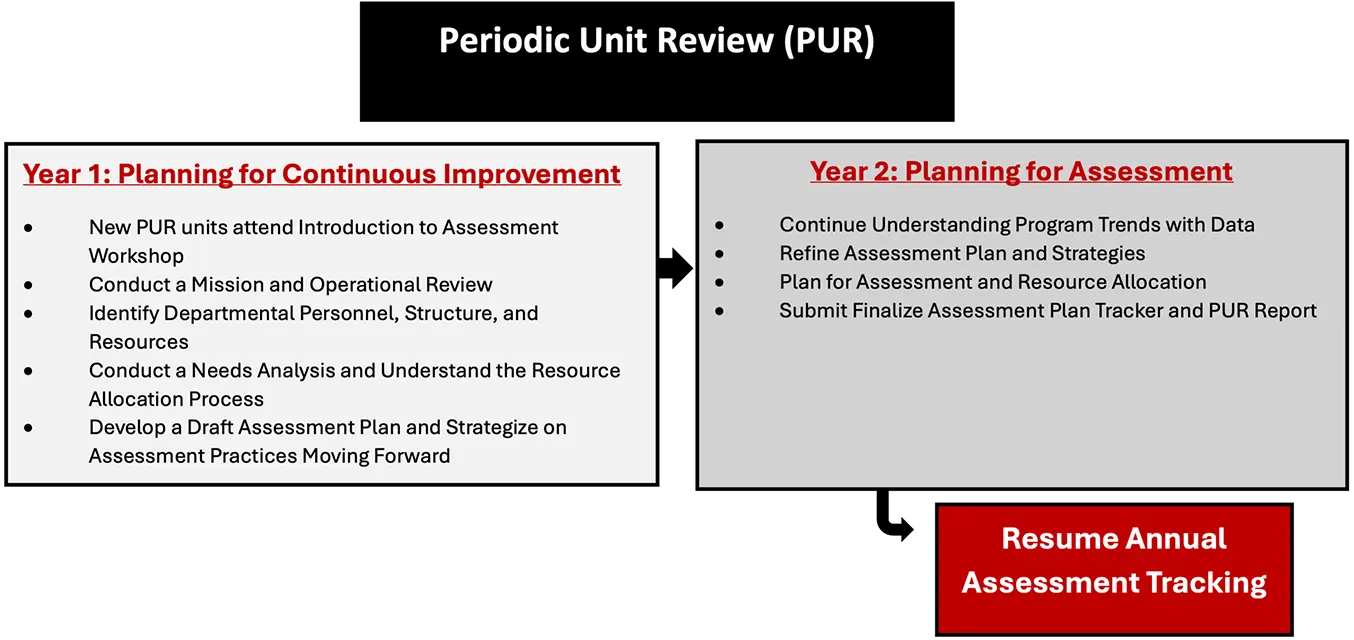
To complete the full cycle of PUR to Annual Assessment Tracking takes 7 years (2 in PUR, 5 in Annual Assessment Tracking). Upon completion of the full 7-year cycle, the process begins again with a new Periodic Unit Review. While mid-cycle interventions in the plan are not typical, they can occur in extreme instances. If this kind of intervention is needed, Units must work with the Office of Institutional Research and Effectiveness (OIRE) as early as possible (more on this topic is included later in the handbook).
Academic Affairs Assessment Plans
Annual Assessment Executive Summaries
Periodic Unit Review
Administration Assessment Plans
Annual Assessment Executive Summaries
As a result of its Periodic Unit Review (PUR), the Development Unit was split into Grants & Sponsored Programs and the LaGuardia Foundation. Consequently, assessment reporting only includes the PUR Report.
Periodic Unit Review
Annual Assessment Executive Summaries
Annual Assessment Executive Summaries
The LaGuardia Performing Arts Center (LPAC) moved from the division of Academic Affairs to Administration, and it functions were re-evaluated. While the unit participated the Periodic Unit Review (PUR) that started in 2022-23, it will not provide final PUR Report. Instead, the unit is reviewed by a consultant.
Adult and Continuing Education Assessment Plans
As a result of their Periodic Unit Review (PUR), the Business Services & Center for Career and Professional Development units were combines into one unit Business and Career Services. Consequently, assessment reporting only includes the PUR Report.
Periodic Unit Review
Annual Assessment Executive Summaries
Communications and External Affairs Assessment Plans
Enrollment Management Assessment Plans
Annual Assessment Executive Summaries
Annual Assessment Executive Summaries
Periodic Unit Review
Annual Assessment Executive Summaries
Periodic Unit Review
President Office Assessment Plans
Annual Assessment Executive Summaries
Annual Assessment Executive Summaries
Annual Assessment Executive Summaries
Periodic Unit Review
Student Affairs Assessment Plans
Annual Assessment Executive Summaries
Annual Assessment Executive Summaries